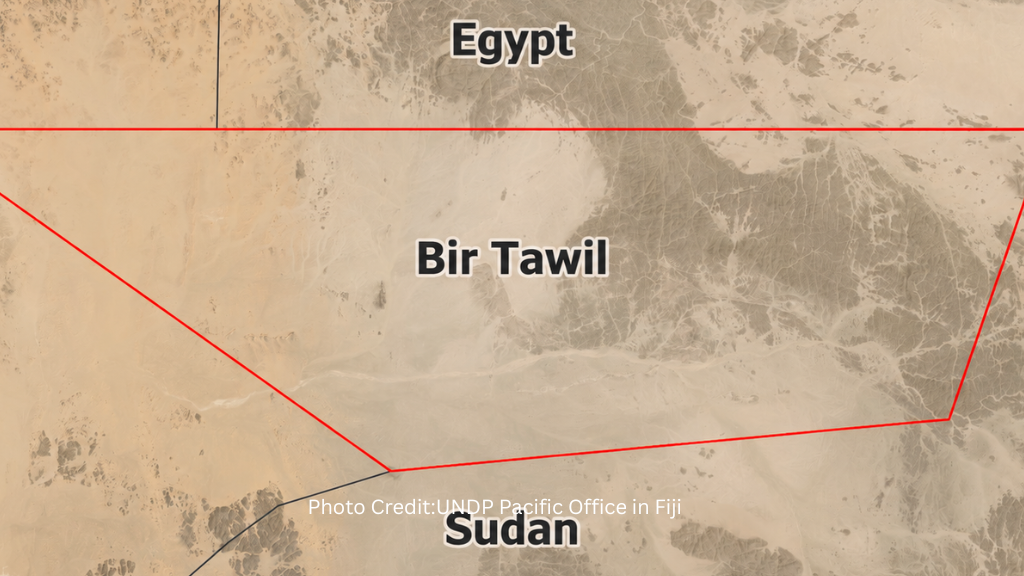
Why no country wants to own this patch of desert
Did you know that there is a stretch of sand in the middle of the desert that technically belongs to… no one? Not to Egypt. Not to Sudan. Not to any recognized country on Earth. It’s not a movie setting. It’s a real place called Bir Tawil.
To understand why Bir Tawil has no flag, no government, and no citizens, we have to rewind to the age of maps drawn with ink and compromise. In the late 19th and early 20th centuries, when European powers and local rulers were carving up borders in North‑East Africa, Egypt and Sudan ended up with two overlapping ways of defining their frontier: a straight “political” border and a more “practical” administrative one.The first major agreement came in 1899, when Britain—then effectively controlling both territories—declared that the border between Egypt and Sudan would follow the 22nd parallel north. Clean, simple, and geometric: everything north of that line would be Egypt, everything south would be Sudan.
But almost immediately, that tidy line met messy reality. In 1902, a second arrangement—an administrative border—adjusted things to reflect how people lived on the ground. Some tribes in the region ranged south or north seasonally, and officials tried to keep tribal lands under a single administration. So the lines were bent.
Here’s where our two key pieces fall into place: Hala'ib and Bir Tawil.Along the Red Sea coast, there’s a larger, more valuable triangle of land called the Hala'ib Triangle. It’s coastal, has access to the sea, and potentially valuable resources. Under the 1899 political border, Hala'ib belongs to Egypt. Under the 1902 administrative border, it falls to Sudan. Both countries want it, for obvious strategic and economic reasons.Bir Tawil, however, is different. It’s a smaller, landlocked four sided of desert to the southwest of Hala'ib. Under the 1899 political border, Bir Tawil lies in Sudan. Under the 1902 administrative border, it belongs to Egypt. In other words, every time Hala'ib switches “ownership” on paper, Bir Tawil flips to the other side.
This created a bizarre legal knot. If Egypt insists on the 1899 treaty, it strengthens its claim to Hala'ib—but it must accept that Bir Tawil belongs to Sudan. If Sudan insists on the 1902 border, it must concede that Bir Tawil is Egyptian while it claims Hala'ib. Each government wants to anchor its legal argument in whichever treaty supports its control of Hala'ib, not Bir Tawil. The result?
Neither Egypt nor Sudan claims Bir Tawil. Officially acknowledging it would weaken their position over the more valuable Hala'ib Triangle. So Bir Tawil becomes something extremely rare in the modern world: terra nullis—literally “nobody’s land.”That phrase, terra nullis, has an almost mythical ring to it, and it has inspired a flood of modern dreamers. Over the past decade or so, various individuals have trekked or proposed to trek into Bir Tawil, planting flags and proclaiming whimsical “kingdoms” or micronations. They see the absence of formal claims from Egypt and Sudan as an invitation.
But international law is less romantic. For a state to be recognized, it needs more than a flag in the sand. It needs stable governance, a permanent population, and—crucially—recognition from other countries. So far, the world has treated these self-proclaimed monarchies of Bir Tawil as curiosities, not real states.
And there’s another reason Egypt and Sudan are in no hurry to embrace Bir Tawil: it’s harsh, remote desert, with no known oil fields, no major mineral deposits, no coastline, and no cities. Compared to Hala'ib, which sits on the Red Sea and has far greater strategic importance, Bir Tawil offers little reward and plenty of legal risk.So you end up with a cartographic oddity. On satellite images, Bir Tawil looks like any other dry corner of the Sahara. But on a political map, it’s a blank anomaly wedge between two modern states—a direct byproduct of overlapping border treaties and unresolved claims elsewhere.
In a world where almost every inch of land is spoken for, Bir Tawil is a reminder that borders are not timeless facts of nature. They are agreements, arguments, and sometimes accidents. And in this case, those accidents have left behind an empty patch of desert that no country wants to own, not because it’s impossible to claim, but because claiming it would cost more—politically and legally—than it’s worth.